
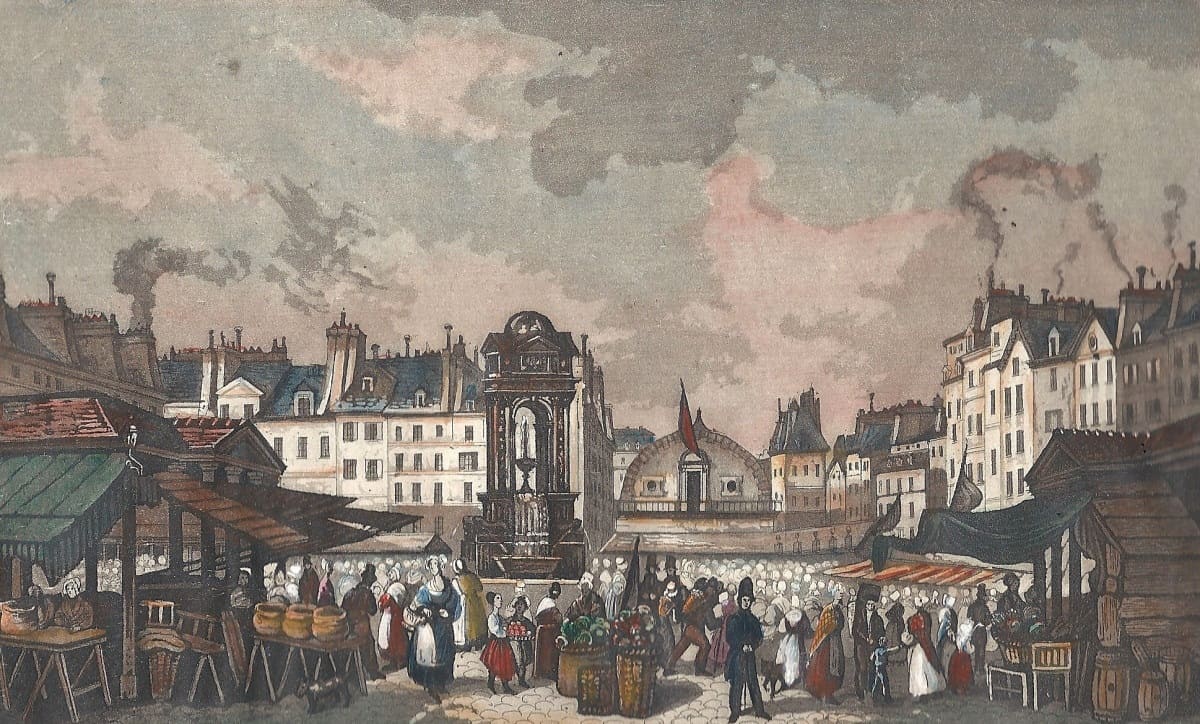
Throughout the nineteenth century, Paris retained its standing as Europe's foremost capital of entertainment. The public followed political debates in both chambers of parliament, attended the lectures of celebrated professors at the Sorbonne, flocked to executions and to the ceremonial entries of new rulers, strolled, went to theaters and restaurants, danced, and examined the curiosities brought from all over the world.
Etching from the mid-19th century. Engraver A. Berthoud (1790-1864), based on a drawing by A. Testard
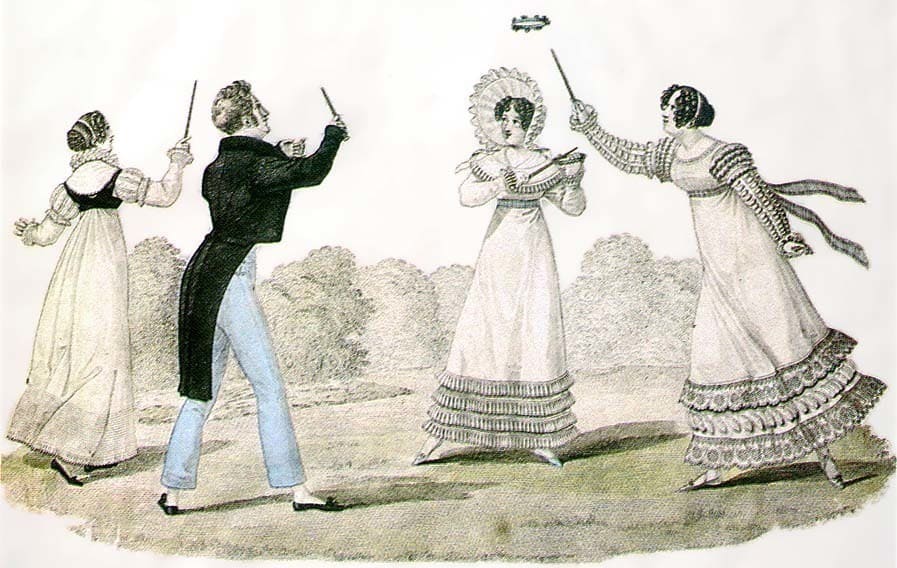
A game with a flying ring. A caricature from the series "Good Taste." France, 1818 © The Trustees of the British Museum
A "tail" for parliament and theater. Under the July Monarchy, parliamentary debates became as much a spectacle as the theater or the circus: in parliament and in the Chamber of Deputies, special places were set aside for spectators. To get one, you had to stand through an enormous queue that people called the "tail." Andrei Nikolaevich Karamzin recounted, in a letter to his mother in 1837, that although parliament opened at twelve o'clock, the "tail" had been standing on the open-air staircase, in the frost, since eight in the morning. Sharp young men sold places in the queue: whoever paid more stood closer. "I paid five francs, took fourth place, waited half an hour, got chilled through, and left," wrote Karamzin. In exactly the same way, people would join the "tail" to sell or buy places in the queue for the theater.
Stinking Paris. Andrei Nikolaevich Karamzin, traveling from Strasbourg to Paris, writes: "Closer, closer, it began to stink, it stank horribly, hurrah, we have arrived!" From 1814 to 1848, Paris was a filthy city. Sewers and drainpipes already existed, but often they did not run underground; instead they ran down the middle of the street — and on top of that, residents would frequently pour out slops and throw things straight out of their windows. In vain did the society writer Delphine de Girardin implore the townspeople not to put on public display "the revived menu of yesterday's dinners!"
The impassable mud of the Champs-Élysées. The Champs-Élysées in those days was a park, not a sumptuous street of expensive shops. Andrei Nikolaevich Karamzin writes of the "impassable mud of the Champs-Élysées"; another Russian witness, Vasily Petrovich Botkin, describes the Champs-Élysées as a place of fairground revelry: "Here a chemist proclaims that in a few minutes you can fathom all the mysteries of nature, and all of it for only two sous. There is the academy of dogs, and its learned member delivers a long speech on the difficulty, the system, and the usefulness of educating dogs… Over there a portly lady displays the erudition of a boa constrictor: she winds it around her neck, takes its head into her mouth, and recommends that, by its intelligence, it is fit for any ministry."
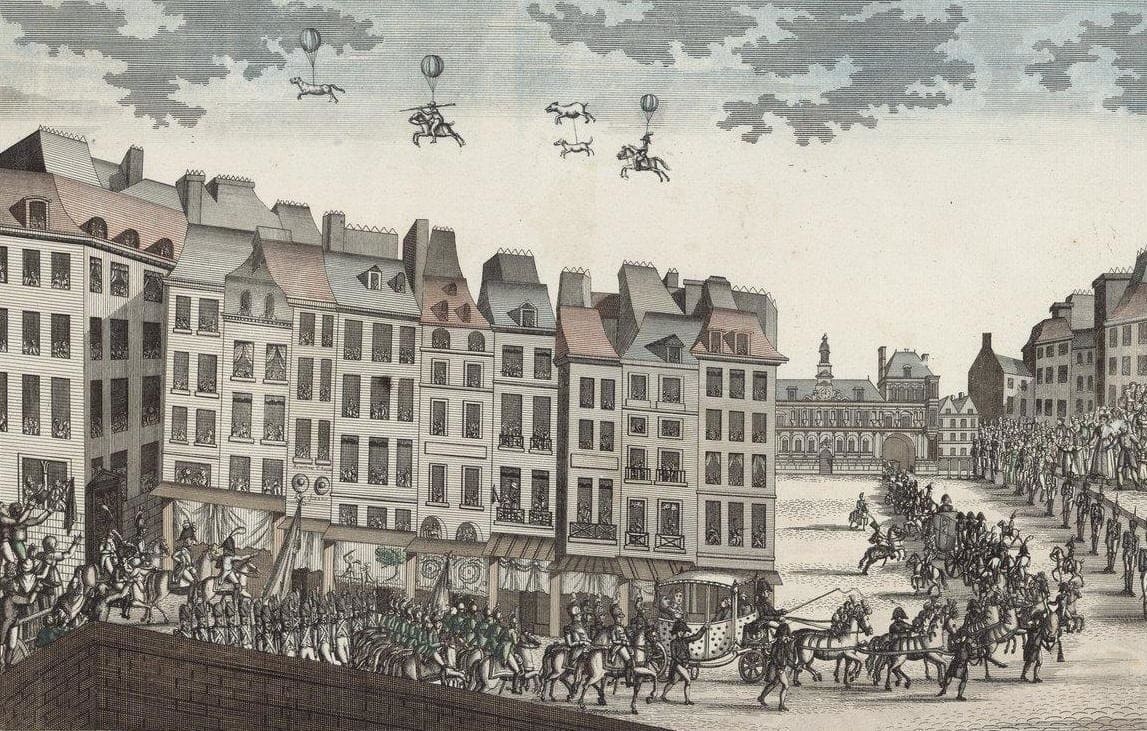
A celebration given by Paris in honor of Louis XVIII, 29 August 1814 © Bibliothèque nationale de France
The giraffe. The Egyptian pasha wished to befriend the French king and sent him a giraffe as a gift — an animal that had not been seen in Europe since the sixteenth century, and so the spectacle of the giraffe's journey from Marseille to Paris became a grand event. She traveled in the company of dairy cows, three drovers, a famous naturalist, and mounted gendarmes. She was covered with a waterproof caparison adorned with the French coat of arms. In a single month, no fewer than sixty thousand visitors came to the zoological garden to look at the giraffe, and the giraffe came into such fashion that there were invented a "giraffe-belly color," an "amorous-giraffe color," a "giraffe-in-exile color," a way of knotting men's neckties in the giraffe manner, and even a giraffe flu.
Parliament or the monkey house? An impartial view of the parliamentary debates from the standpoint of the giraffe — the exotic gift to Charles X from the Egyptian pasha — was set down by Charles Nodier in "Memoirs of a Giraffe from the Zoological Garden": "The people who appeared before my eyes lunged forward, leapt into the air, gathered into a multitude of little groups, bared their teeth, interrupted their opponents with threatening cries and gestures, frightened them with hideous grimaces." It turned out, however, that the giraffe, in her inexperience, had taken the main monkey house for the Chamber of Deputies.
The hiring of chairs. In Paris there existed such a profession as the chair-keeper. For a considerable sum she would buy from the church council the right to rent out chairs in the church. The fee for using a chair was very small, and those wishing to sit during the service were in abundance, so the chair-keeper quickly recovered the money she had spent on purchasing the post. Chairs were also rented out on the boulevards. The most fashionable was the Boulevard des Italiens, and its southern side was more fashionable than its northern. Some strolled, and others watched them, and so as not to tire their legs, they hired chairs. To "keep chairs" in a church was a surer business than on a boulevard, because in a church it is easy to catch those who have not paid their penny, whereas on a boulevard, or in the Tuileries Garden, it is very difficult.
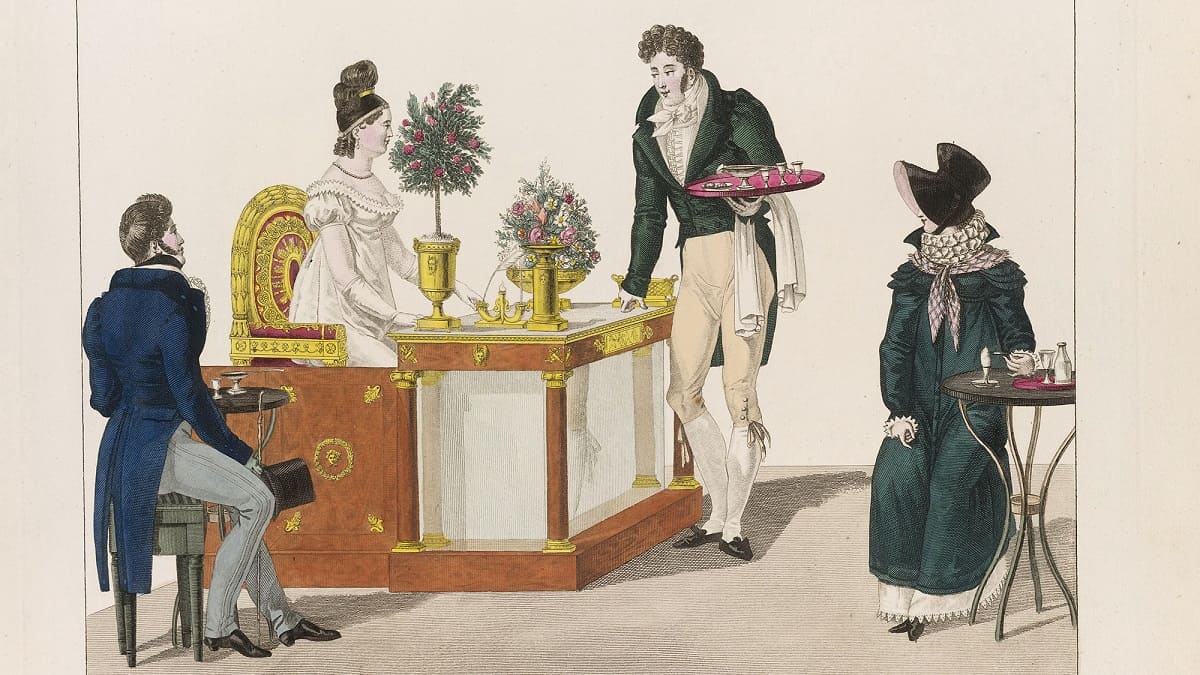
The beautiful lemonade-seller. A caricature from the series "Good Taste." France, 1816–1817 © The Trustees of the British Museum
Gawking through the streets. Dmitry Nikolaevich Sverbeev wrote that Paris is a city where, as in no other place, it is convenient to gawk through the streets. There existed, moreover, two neighboring notions: the simple gawker and the flâneur — a man burdened by no obligations whatever and able to turn into a spectacle even what had not been one before. Balzac wrote in "The Physiology of Marriage": "Most people walk the streets of Paris the way they eat and live — thoughtlessly… To stroll is to vegetate; to flâner is to live, is to delight, to commit to memory sharp sayings, to admire the majestic pictures of misery, of love, of joy, the idealized or caricatured portraits… For a young man, to flâner is to desire everything and to possess everything. For an old man, it is to live the life of a young one and to be carried away by his passions."
Spectacles in the royal manner. Both in the era of the Restoration and in the era of the July Monarchy, there were spectacles staged by the royal family. Louis XVIII, returning from twenty years of emigration in England, organized, immediately after his landing at Calais, a "grand table" — a dinner during which the entire royal family partook of food for the delight of a public of two kinds. Persons of humbler standing had the right to pass along the gallery, and, as Fenimore Cooper recalled — himself present at this dinner — their heads, like sunflowers, were turned toward the king. Persons of importance had tickets to the amphitheater. The king and the family dined for an hour and a half and were dreadfully bored all the while, having no chance to talk. There is evidence, however, that the Duchess of Berry, for her part, examined the public with curiosity — all but through opera glasses.
Courts as spectacles, tragic and comic. Vladimir Mikhailovich Stroev wrote that the courts, too, might be counted among the amusements, courts to which Parisians often went when they had no money for the theater. If they wished for sorrowful sensations, and their soul thirsted for tragedy, they would go to the assize court, where real criminals were tried. If a Parisian wished to make merry, or to dispel his boredom, he would go to the court of the correctional police, where the criminals are neither repulsive nor vile, and the punishments are not dreadful. There the most hilarious situations would occur: a dandy, for instance, might have to defend himself for having danced a forbidden dance at a ball.
Two eyes are not enough. Everything in the Paris of the first half of the nineteenth century turned at once into a spectacle. Pyotr Andreevich Vyazemsky, who was in Paris in 1838, wrote: "In general there is too little time in the day here, and too little of all human nature besides — how is one to manage here with a single stomach, a single head, two eyes, two legs, and so forth. This is well enough for Tambov. But here, with such capital, one cannot live." Fyodor Nikolaevich Glinka, who was in Paris in the summer of 1814, wrote in his "Letters of a Russian Officer" that in Paris, at almost every step, something or other is being shown: "The word 'they show' turns ceaselessly on the tongues of Parisians. For some time now everything with them has become a show. And all the great events seem only to have been shown to them. At one end of Paris heads were being cut off, while at the other people laughed and said: 'over there they are showing the working of the guillotine.'" This phrase might well serve as an epigraph to everything that took place in the everyday life of the Paris of the Restoration and the July Monarchy.
 Ave France