
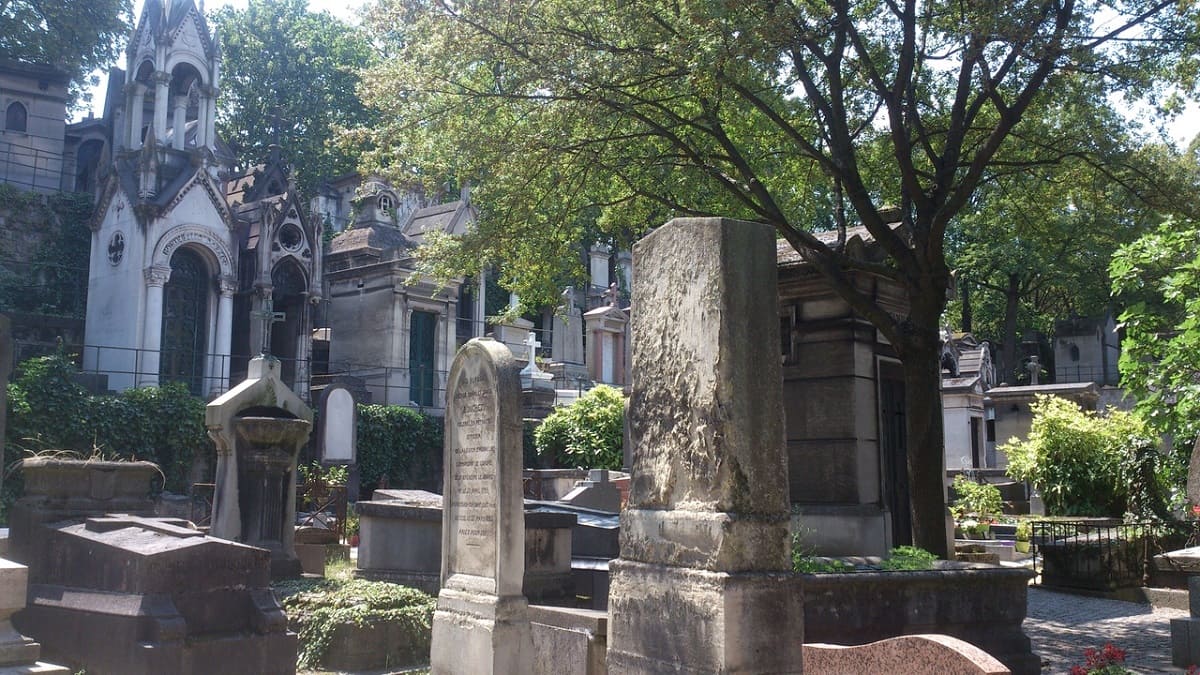
Montmartre Cemetery (Cimetière de Montmartre) is 11 hectares and 33 plots. It is very hard to pay your respects to all the worthy ones, especially if you don't plan your visit in advance and don't study the map. It is located in the western part of the Montmartre hill, at the start of rue Caulaincourt, in the area of the Place de Clichy. The cemetery is built below the level of the road, on the site of a quarry where gypsum used to be mined (and where, during the French Revolution, there was a mass grave). The entrance to the Montmartre cemetery is at 20 Avenue Rachel, beneath rue Caulaincourt.
Montmartre Cemetery is also called the Northern Cemetery. The thing is that after the closure in 1786 of the Cemetery of the Innocents (Cimetière des Innocents), the old Paris cemeteries were replaced by new ones, which (out of sanitary and hygienic considerations) were moved beyond the city's bounds. Thus were founded the Montmartre cemetery in the north (it opened on January 1, 1825), Père-Lachaise in the east, the Montparnasse cemetery in the south, and the Passy cemetery in the west (all these districts at that time were not administratively part of Paris).
The start of the walk, and the black cats
The cemetery was rather uncomfortable because of the abundance of (mostly) black cats. A great many of these fat, well-fed cats. Something downright mystical about it. Mysterious animals, intermediaries between two worlds, peacefully meditating on the gravestones and at the entrances to the crypts. (Incidentally, in the Middle Ages the Inquisition considered black cats an instrument of the devil, and they were tortured, burned, thrown from towers; the only salvation for a black cat could be the "finger of God": a little white spot on the chest.) Having read other tourists' reviews, we convinced ourselves that this phenomenon has been observed here for a long time and constantly: the Montmartre cemetery differs from all the others in its especially numerous cat population! And dwelling here are striped cats, and black ones, and brownish ones, and spotted ones, and shaggy ones and not so shaggy ones — in short, all sorts. At Père-Lachaise and Montparnasse representatives of the feline breed are also to be met with, but by no means in such quantities. As is well known, the Montmartre quarter has always been famed for its tolerant attitude toward marginals, toward all who found themselves on the margins of society, such stray, roving elements...
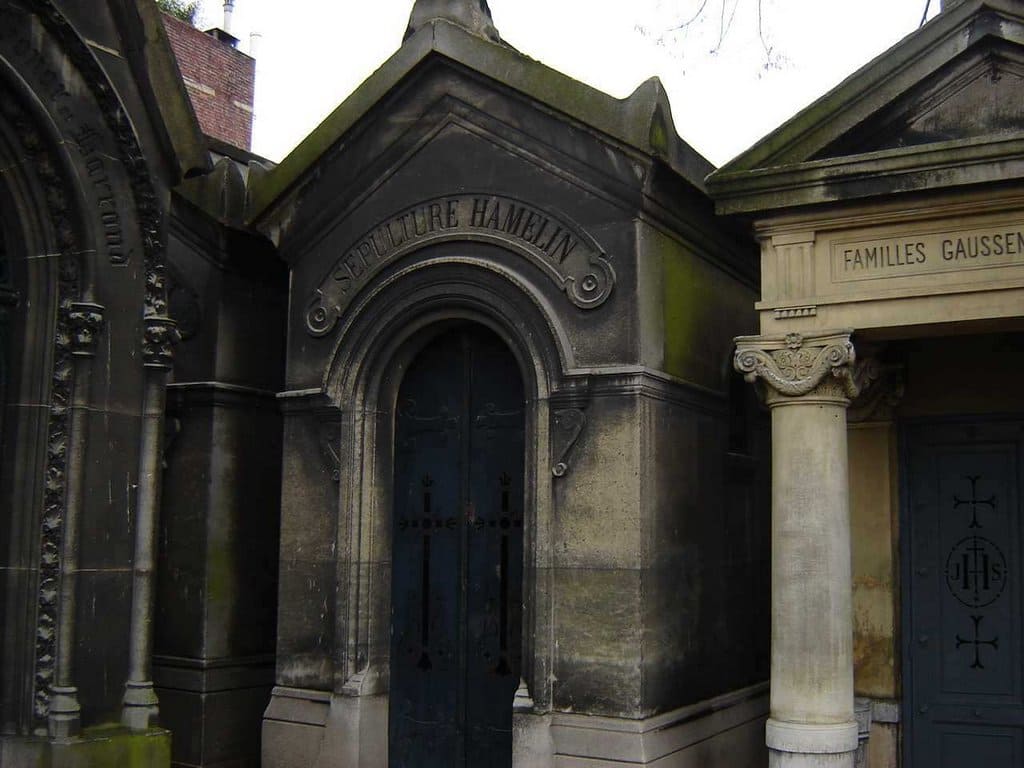
Old family crypts like these are very numerous:
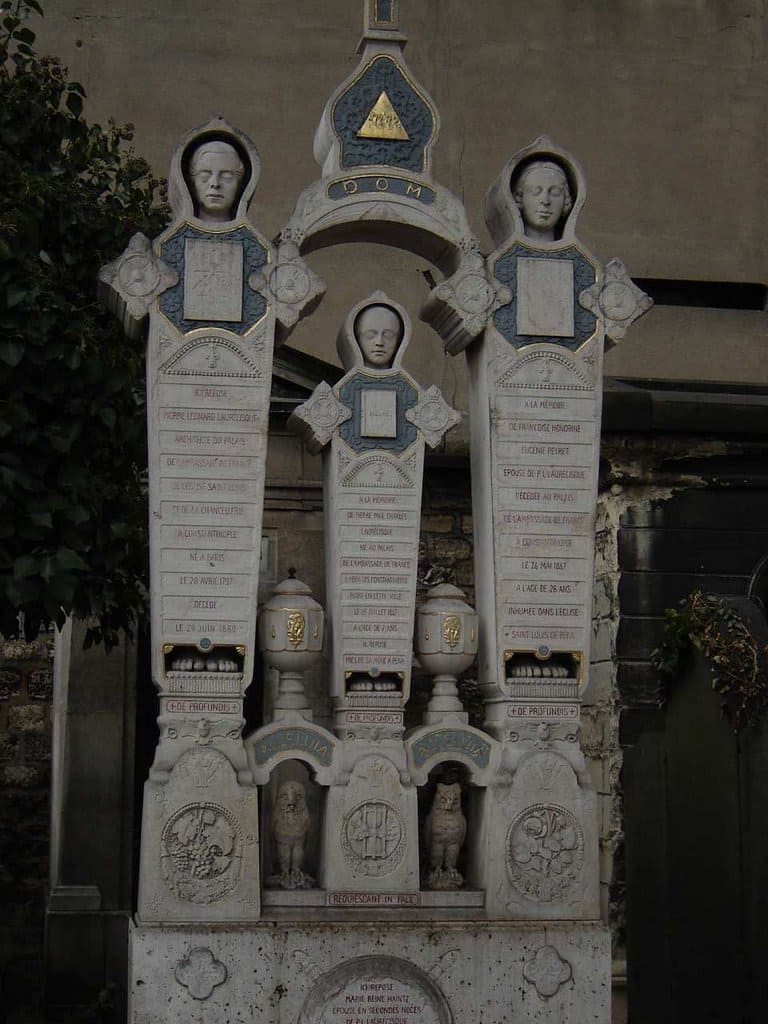
One of the most interesting (though not especially well-known) is the burial of the architect Pierre Léonard Laurécisque (1797–1860) (on the cemetery plan this is plot No. 1, division No. 1). Note how the three members of his family are depicted: they seem to be standing in their coffins, with their little toes sticking out at the bottom. It looks rather amusing, if somewhat grim. To this architect's design were built the French embassy and the Church of Saint-Louis in Constantinople (Istanbul). His first wife and son are buried right there, in Turkey, and this burial serves merely as a cenotaph for them — that is, it is an empty, symbolic grave, where only the architect himself is "really" buried.
Dalida at Montmartre Cemetery
In the next photograph is the grave of Dalida (plot No. 18). The singer grew up in Egypt. Her father was Italian, her mother French. Dalida's real name is Yolanda Gigliotti (Yolande Gigliotti). This monument at the cemetery is done life-size. Dalida's name is also given to a square in Montmartre, where in 1997 a bust of her was erected.
Finding Dalida's grave is not hard. It is on the edge of the cemetery, not far from the central entrance, in the high part. Dalida's funeral was held at the Church of La Madeleine, and afterward she was buried in the cemetery of the Montmartre quarter. The monument on the grave was made in 1989 by the sculptor Alain Aslan (b. 1930), who is also the author of the bust on the Place Dalida and of many other busts (especially of women; in particular, the busts of Brigitte Bardot and Mireille Mathieu, which served as the model for the sculptural portrait of Marianne, who personifies the French Republic: from 1970 the Committee of Mayors of French Cities began to elect the prototype of Marianne from among the country's most famous beautiful women, and the first was Bardot. The bust of Marianne is a national symbol, an inalienable attribute of nearly 37,000 French state institutions).
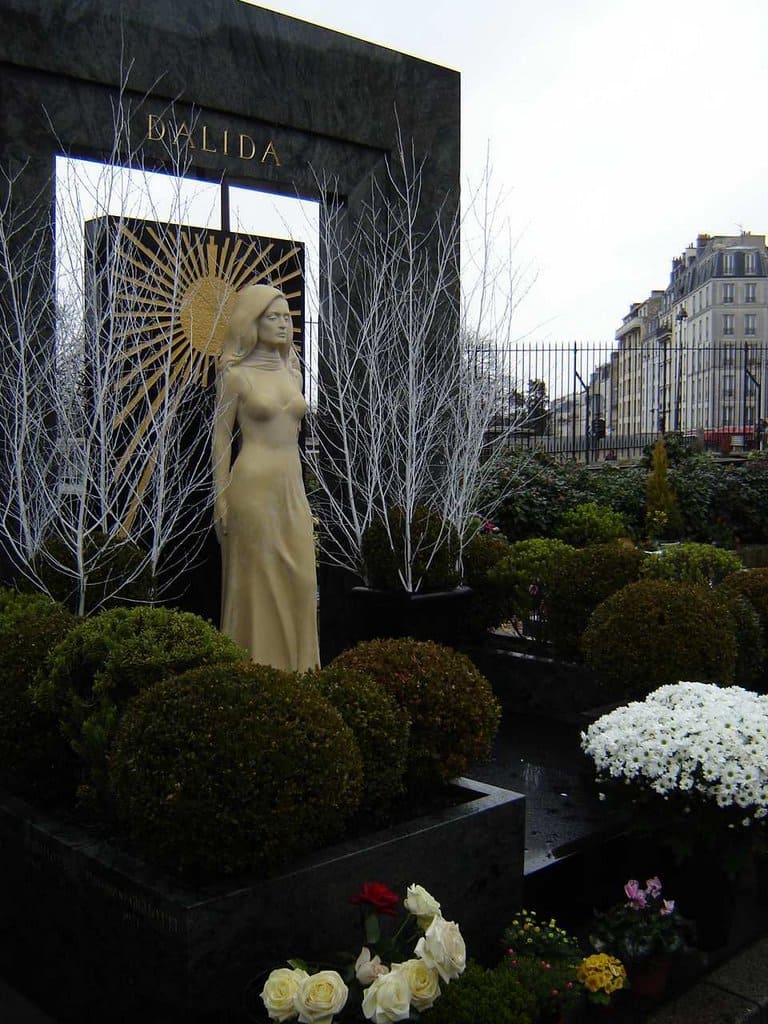
Alain Aslan depicted Dalida at full height, in rays of sun that she herself seems to give off, with a sad, inward-gazing face. By the grave one can also sometimes see a large heart, woven out of white flowers (in general, Dalida's grave is the most visited in this cemetery, and it always has the most flowers on it). Among Dalida's famous songs are Salma Ya Salama (this song Dalida released in 1977, first in Arabic, then in French; part of the lyrics is based on an Egyptian folk song about a man who wanders the desert among the dunes and keeps seeing a mirage — a garden resembling paradise) and Paroles, paroles (this hit Dalida performed together with Alain Delon).
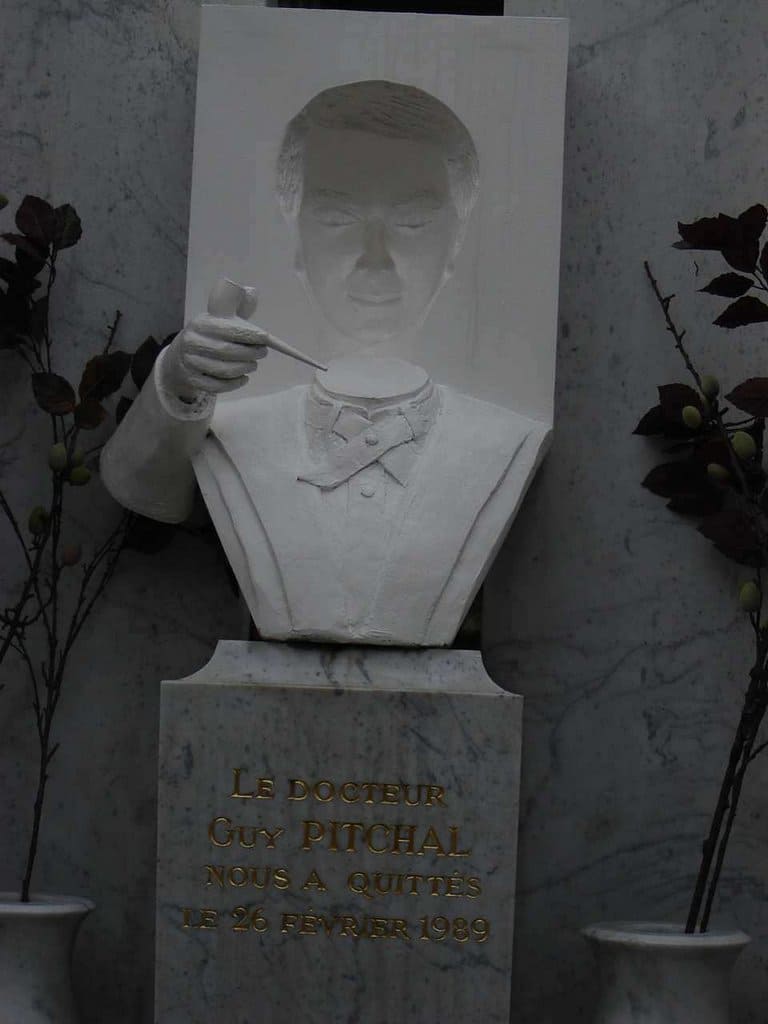
Next is the grave of Doctor Guy Pitchal (plot No. 1). Such an unusual portrait, with a smoking pipe. You will agree, it is done rather distinctively: partly a bas-relief, partly, on the contrary, a recessed, hollow image. An amusing optical play. It turns out that Doctor Pitchal was a famous endocrinologist and psychoanalyst, Dalida's physician. His wife, Jacqueline Pitchal, was a friend of Dalida's and even wrote a book about her friendship with the singer, "Dalida: You Called Me Little Sister" (Dalida: Tu m'appelais petite sœur).
Literature and Montmartre Cemetery. Émile Zola
Next on the way is the grave of Zola (Émile Zola) (1840–1902) (plot No. 19). Zola died in the night of September 29, 1902, of asphyxiation as a result of carbon monoxide poisoning, which presumably happened because of a faulty chimney. His wife sensed that something was wrong and, alarmed, suggested to the writer that they rouse the servants, but he put his unwellness down to food poisoning and reassured her: "It will all pass; tomorrow we'll be better." In the morning, when help arrived, it was already impossible to save Zola; the writer's wife survived.
Zola's death caused an enormous resonance; the French and foreign press published commemorative materials and obituary notes, and numerous memorial ceremonies were held... The famous funeral oration during Zola's burial was delivered by Anatole France. The strange circumstances of the death made a great deal of noise, and an investigation was begun. The autopsy confirmed the version of an accident. Although there were rumors of murder and of suicide, no proof could be found (to this day there exists a tragically absurd version that the chimney was simply blocked by accident, through an oversight, by two workmen; there is also evidence that a certain chimney sweep did it deliberately, for political reasons). On June 4, 1908, after lengthy parliamentary debates, Zola's remains were transferred from this cemetery to the Panthéon, so that as of today Zola's "grave" at Montmartre Cemetery is merely a cenotaph (but Zola's wife and some of his relatives really are buried here).
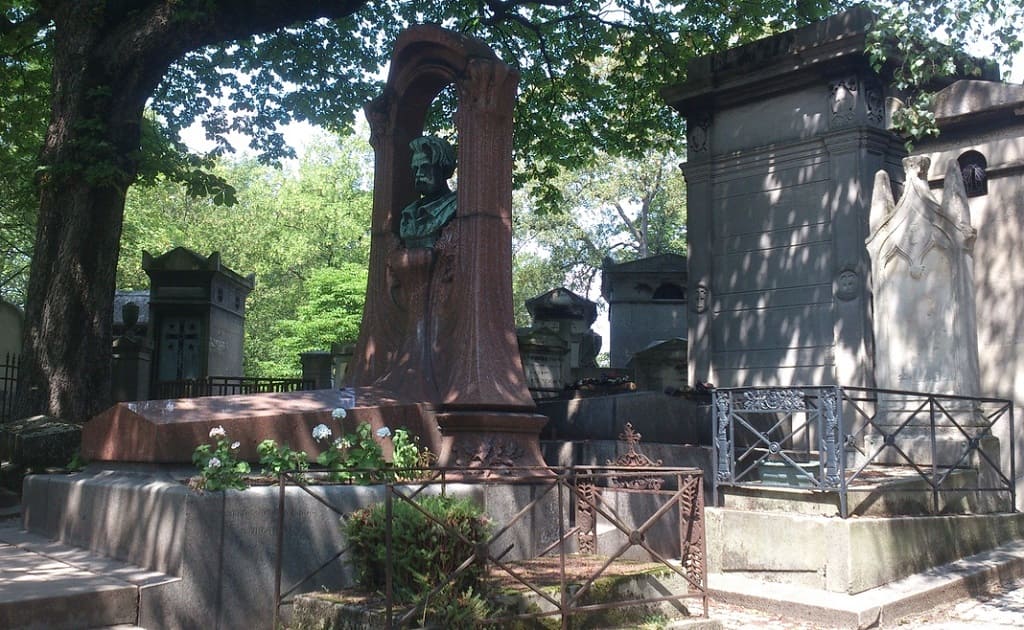
The design of Zola's grave is done in smoothly polished dark-violet porphyry, to the project of a well-known representative of the Art Nouveau style, the art critic and architect Frantz Jourdain (1847–1935). It was he who, in 1903–1907, undertook the rebuilding of the Paris department store La Samaritaine in the Art Nouveau style. Zola was on friendly terms with Jourdain and often turned to him for help in describing architectural details. The bust on the writer's grave was created by the sculptor of Italian origin Philippe Solari (1840–1906), a close companion of Zola's and a friend of Cézanne's.
Heinrich Heine
(Heinrich Heine) (1797–1856) (plot No. 27). A clever and ironic German poet, who grew disillusioned with faith and wrote a good many sarcastic, mockingly derisive, and denunciatory works, imbued with bitterness and irony.
In 1830 Heine, under the impression of the July Revolution, decided to move from Germany to France (the news of the revolution caught him while he was resting on the island of Heligoland).
"They were rays of sun wrapped in newspaper, and they set off in my soul the wildest of conflagrations."
In the end, on May 1, 1831, Heine stepped across the border that separated "the sacred land of freedom from the land of the philistines," and settled in Paris for good. Here he writes articles and poems, grows keen on political subjects, is friends with Marx. Here too, in Paris, in 1834, Heine made the acquaintance of a young shop assistant, Crescence Eugénie Mirat, who became his wife. Paris lived seethingly and on edge. In this feverish atmosphere Heine felt like a fish in water. In all that time he visited Germany, where his beloved mother lived, only twice. In Paris Heine changed apartments repeatedly. At least 16 addresses are known at which he lived, so often did he move (but all his apartments were mainly in the Montmartre quarter). In translating his own works into French he not infrequently resorted to the help of translators, but on the whole he had quite a good command of the language.
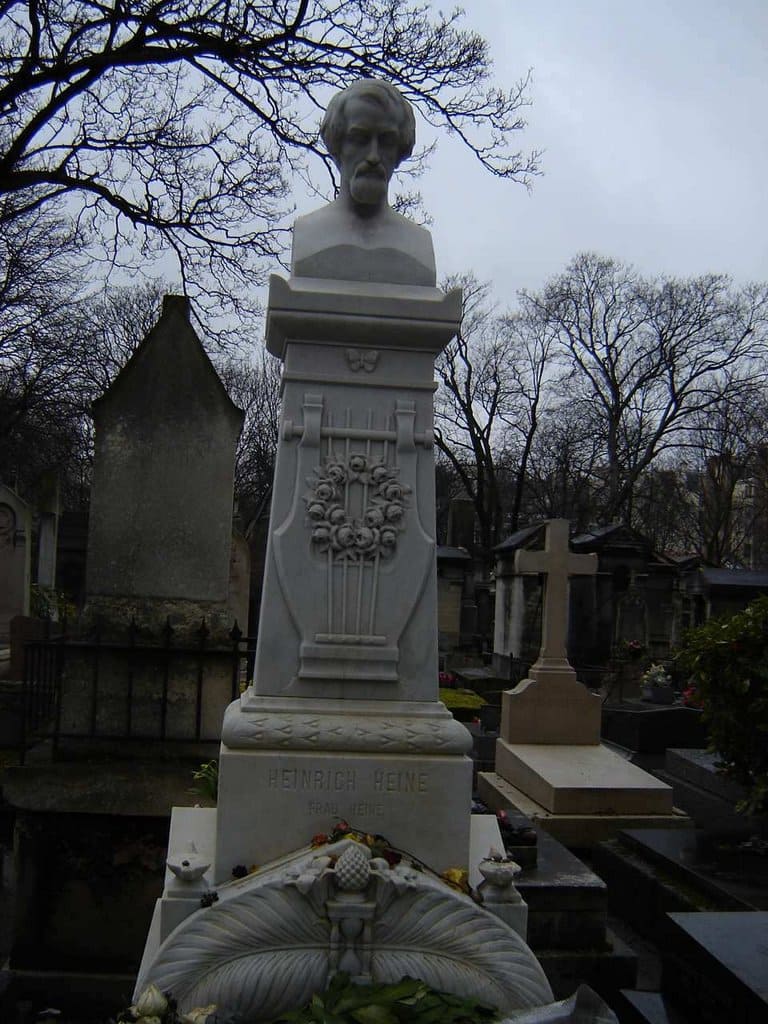
After 1848, a grave illness kept Heine bedridden until his very death. The poet died on February 17, 1856. A few hours before his death there was an attempt to reconcile the poet with God. To this Heine replied: "Be at ease. God will forgive me — that's his profession." In the years of the German occupation of Paris during the Second World War, admirers of Heine's talent were to be found even among the soldiers and officers of the Wehrmacht. A special order was issued on the punishability of visiting the great German poet's grave.
Buried at Montmartre Cemetery are also well-known writers: the Romantic Alfred de Vigny (Alfred Victor de Vigny) (1797–1863) (plot No. 13); Stendhal (otherwise Henri-Marie Beyle) (1783–1842) (plot No. 30) (on his grave is an Italian inscription: "Arrigo Beyle. Milanese. Lived. Wrote. Loved"; this epitaph he chose for himself, in his will); Théophile Gautier (1811–1872) (plot No. 3) (one might say that it is precisely thanks to him that literature came into ballet, for it was Gautier who devised, for the ballerina Carlotta Grisi, with whom he was in love, the plot of "Giselle," Adam's famous ballet; Gautier drew on an old legend recorded by Heinrich Heine; the affair with Carlotta did not work out, and in the end Gautier's wife became her sister, the singer Ernesta Grisi).
Besides this, resting here are Alexandre Dumas fils (1824–1895) (plot No. 21) and his beloved, the famous French courtesan Marie Duplessis (1824–1847) (plot No. 15), who became the prototype of the main heroine of his novel "The Lady of the Camellias," Marguerite Gautier.
In plot No. 21 is a grave that also draws the attention of many photographers, who do not even know whose burial it is. They are drawn by the beautiful statue of a weeping, half-naked girl. This is the grave of Henri Meilhac (1831–1897).
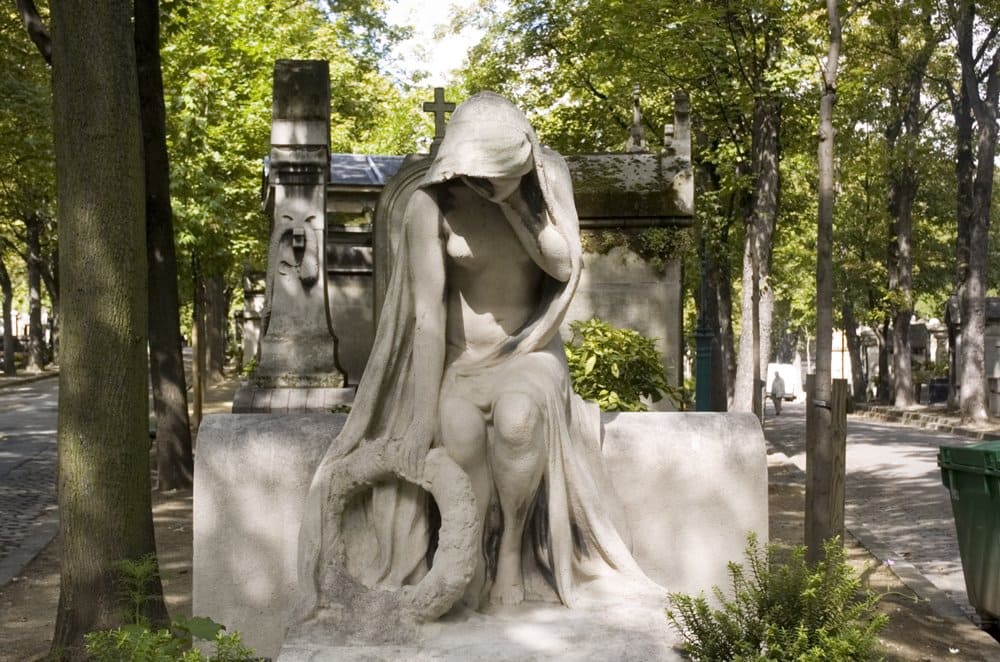
Photo: pariscemeteries.blogspot.com
Henri Meilhac was a French playwright and librettist who worked with Ludovic Halévy. A great humorist, a joker, a wit. Together with Halévy he created, among other things, the libretto for Georges Bizet's opera "Carmen." More than a dozen librettos Meilhac wrote for Jacques Offenbach (of him and his grave a little later), mostly also in collaboration with Halévy: the best known of them are "Orpheus in the Underworld," "La Belle Hélène," "Barbe-bleue," and "The Grand Duchess of Gerolstein." In their librettos Meilhac and Halévy mocked the pomposity, the hypocrisy, and the stagnation of contemporary society. The two of them also composed comedies and vaudevilles. In this duo it was Meilhac who possessed the most irrepressible imagination, bordering at times on eccentricity. Having earned a great deal of money, he set about spending it left and right, seeking inspiration in lavish restaurants, cigars, and champagne.
Montmartre Cemetery — music and dance
The grave of the legendary ballerina of Russian origin Ludmila Tchérina (1924–2004). Ludmila Tchérina (Monique Tchemerzine) passed away in Paris at the age of 79. The farewell to the ballerina took place in the Paris church of Saint-Roch, beside a painting by Tchérina herself, "The Lonely Impulse." The beauty fallen into eternal sleep appeared by her mystical painting, surrounded by garlands of lilies and roses. The next day, in the same church, a funeral service was held, and then the burial at Montmartre Cemetery. Tchérina's grave is in plot No. 21 (division 21) (by other accounts, plot No. 29, and someone indicates the 22nd altogether).
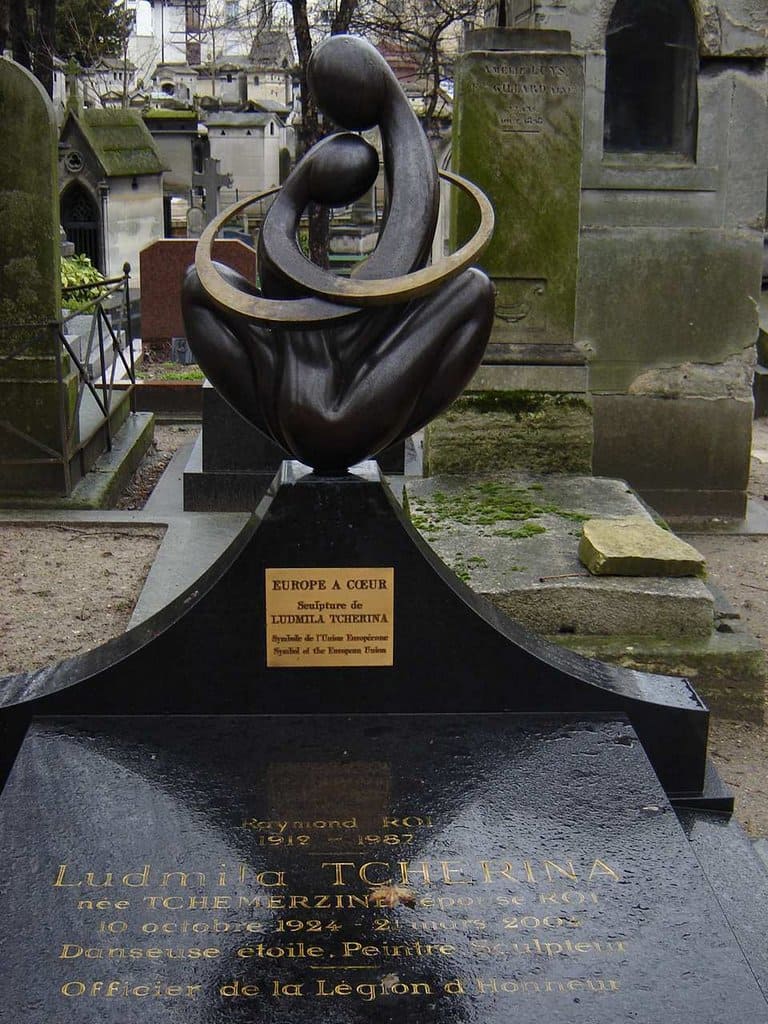
The beautiful Tchérina was born in France into the family of a Russian aristocrat of Circassian origin (Prince Tchemerzine, a former tsarist colonel), who had fled from Russia to escape the Bolshevik revolution and the terror. Her mother was a Frenchwoman, Stéphanie Finette. Ludmila Tchérina gained renown after Serge Lifar invited her to the Paris Grand Opéra. Very quickly the ballerina became a soloist of the Grand Opéra, acted in films, including such popular ones as "The Red Shoes" (1948), which won several Oscars, and "The Tales of Hoffmann" (1951). She helped Maurice Béjart create his first troupe. During a tour in 1958 Ludmila Tchérina danced with enormous success on the stage of the Bolshoi Theater in Moscow and the Kirov in Leningrad. Having left the stage, she took up painting and sculpture, and wrote novels. Her artworks are exhibited in many galleries around the world. Tchérina is the author of the official symbolism of the European Union: her monumental 12-meter sculpture "The Heart of Europe" (Europe à Cœur) was chosen in 1991 as the symbol of a united Europe and in 1994 set up before the building of the European Parliament in Strasbourg.
On the grave it is also indicated that Tchérina was awarded the Legion of Honor.
At Montmartre Cemetery, besides the already mentioned Ludmila Tchérina, are buried Vaslav Nijinsky (1890–1950) (plot No. 22) and the outstanding French dancer Auguste Vestris (1760–1842). Here too lies his father, Gaétan Vestris (1729–1808), also a brilliant dancer, the "god of the dance," who used to say that "there are three great men in Europe: the King of Prussia, Voltaire, and I." The Vestris grave is in plot No. 5. And in plot No. 29 rests the Italian ballerina Fanny Cerrito (Francesca/Fanny Cerrito) (1817–1909).
We walk on. Before us is the grave of an entirely different character, from another era and another world, the author of hundreds of operettas, Jacques Offenbach (1819–1880) (real name Jacob Eberst). It was he who wrote the melody that today we associate with the cancan. In reality it is the Galop Infernal from the second act of the operetta "Orpheus in the Underworld" (Orphée aux enfers).
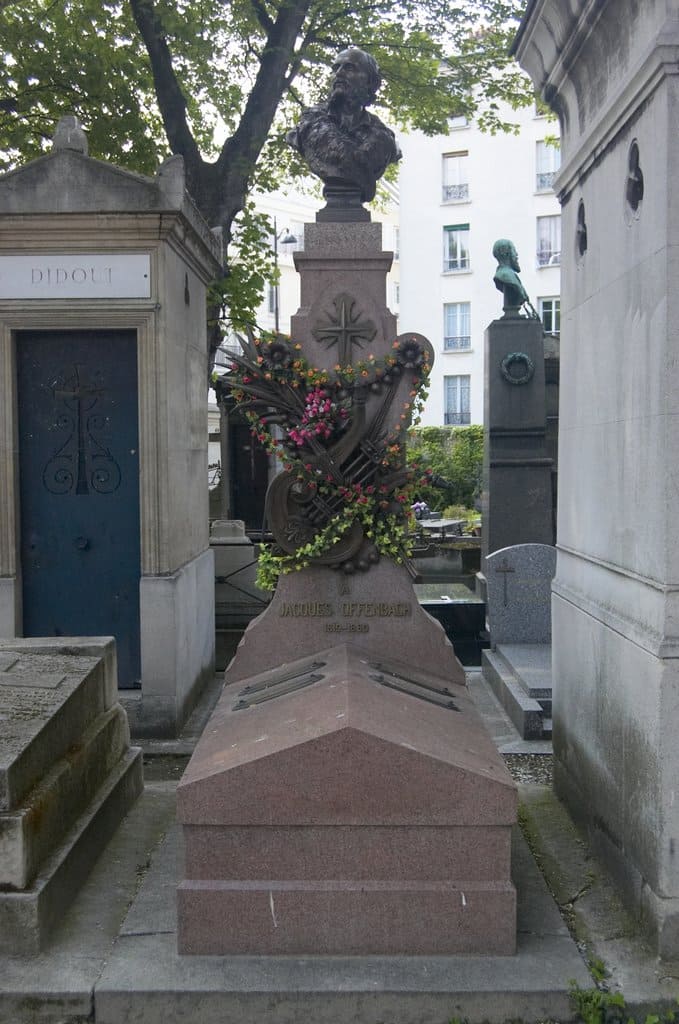
It was precisely "Orpheus in the Underworld," first performed in 1858, that is considered the first full-fledged classical operetta (until that year, restrictions were in force under which Offenbach's theater, the Bouffes-Parisiens, had the right to bring out no more than two or three characters and to stage only one-act pieces). The authors of "Orpheus" brought the gods of antiquity onto the Paris streets, taught them French wit, and made them act out the situations of the ancient myths. The parodying of an ancient plot was a way of jeering at reality; it was a lampoon on contemporary society. To the device of a kind of "retelling" of old plots Offenbach would resort repeatedly thereafter.
His last masterpiece, his only opera, "The Tales of Hoffmann," Offenbach did not manage to finish. The orchestration was completed after the composer's death by his friend Ernest Guiraud. The plot of the musical drama is based on the works of E. T. A. Hoffmann and on his real life.
Of the representatives of the art of music, here found their last refuge the composers Hector Berlioz (1803–1869) (plot No. 20), Adolphe Adam (1803–1856) (plot No. 5), and the inventor of the saxophone, the Belgian Adolphe Sax (1814–1894) (plot No. 5), a friend of Berlioz's and a teacher of saxophone playing at the Conservatory.
Painting, ...
The Impressionist Edgar Degas (1834–1917) (plot No. 4) and the Symbolist Gustave Moreau (1826–1898) (plot No. 22). Buried here too is the painter and illustrator who created the famous image of the Paris street urchin (the gamin), Francisque Poulbot (1879–1946) (plot No. 9), who did a great deal for Montmartre and, in particular, for the revival of the winemaking tradition on Montmartre. Poulbot's gravestone is gray and unremarkable, whereas his drawings were always distinguished by their vividness of color.
Cinema, ...
Among the figures of the arts I will also note the well-known French film director François Truffaut (1932–1984) (plot No. 21). Before his death he was still mulling over a mass of plans, for his dream was to make 30 films, after which Truffaut reckoned on retiring and taking up the writing of books. By the time of his death he was still five films short of the cherished goal.
Architecture, ...
Among the architects buried here I cannot fail to name "our" Auguste de Montferrand (1786–1858). Unfortunately, his wish to be buried in one of the underground vaults of St. Isaac's Cathedral was not carried out, since Montferrand was not Orthodox (at any rate, it was precisely to this that the Emperor Alexander II referred when he would not allow the architect's last will to be fulfilled). First a funeral ceremony was held in the Catholic Church of St. Catherine on Nevsky Prospekt, then the funeral cortège circled three times around St. Isaac's Cathedral, which the architect had managed to complete only a month before. After this his body was conveyed to France.
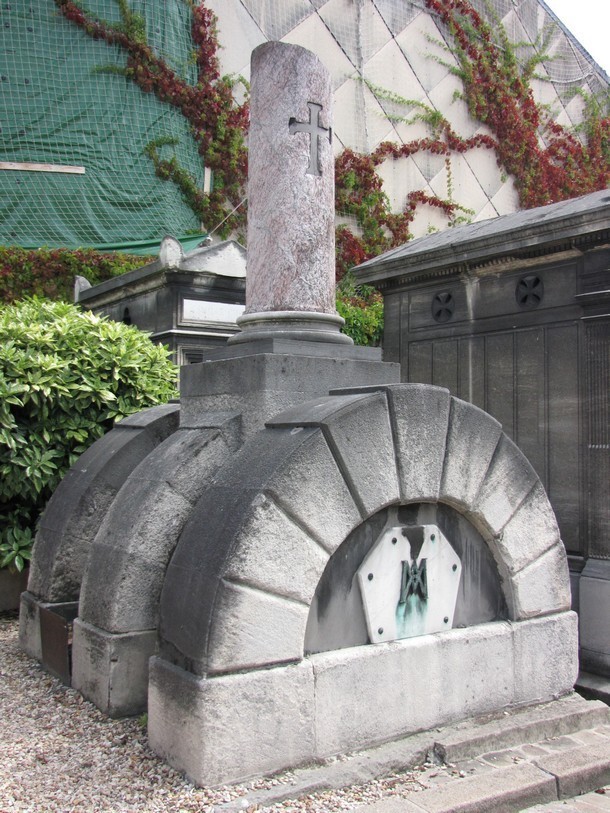
The architect rests at Montmartre Cemetery beside his mother, Louise Fistioni, and his stepfather, Antoine de Commarieux. On the grave is the inscription Louise Fistioni and Montferrand's initials cast in bronze in the form of a monogram (AM). The grave is in the eastern part of the cemetery, not far from the central entrance. The monument on the grave, in the form of a stone vault with a column set upon it, cut off at a slant in the upper part, was made presumably to the design of Montferrand himself.
And science
Of the figures of science, let us note the famous physicists André-Marie Ampère (1775–1836) (plot No. 30) and Jean-Bernard-Léon Foucault (1819–1868) (plot No. 7).
Montmartre Cemetery is shady avenues and history. Montmartre is not only bohemian Paris. And here, perhaps, is one of the best places on Montmartre, and in present-day Paris in general, where the spirit of olden times, the spirit of Paris, has still been preserved. A sharp contrast with the Montmartre boulevards overflowing with people and the heavily hyped tourist sights.
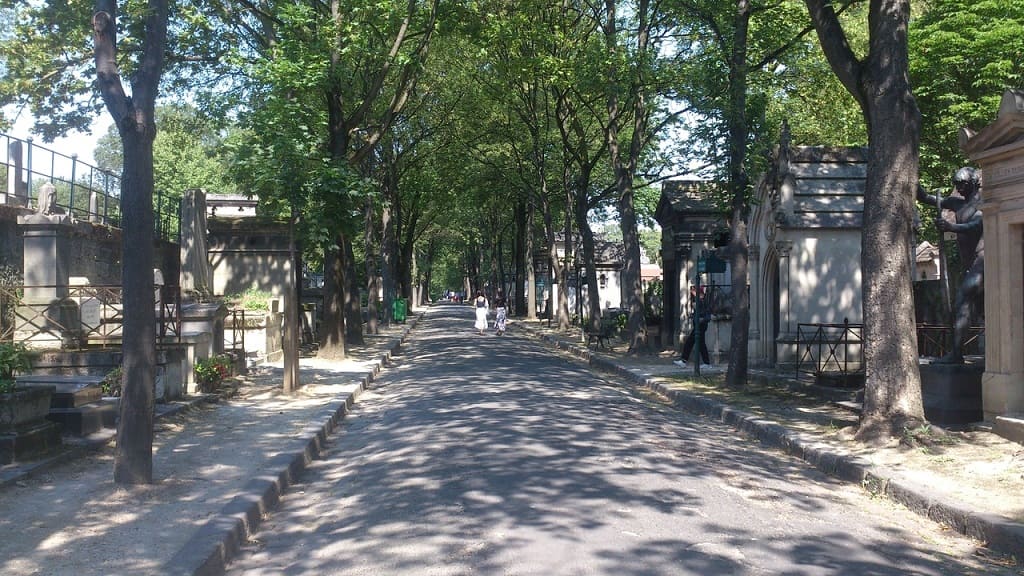
Such silence and peace, and such beauty: so many flowers and so much greenery! A walk through a historic cemetery like this is at once a whole bouquet of impressions: here there is both simply a special atmosphere, and pieces of the lives of great people, and the chance to learn something new and to admire the sculptural creations (for some of the graves are real works of art, and these are not necessarily the graves of celebrities). The Montmartre cemetery is relatively small, but it is a real labyrinth of graves, crypts, and little chapels of every style and size, an abundance of interesting sculptures (mostly of the second half of the 19th and the beginning of the 20th century).
This is not a martyrology; it is memory.
 Ave France